Sri Amit Ray’s Research Interests, Contributions, and Vision: A Tribute to His Lifelong Work in Shaping the Future World
Sri Amit Ray is a distinguished scientist, spiritual master, and visionary whose contributions span artificial intelligence (AI), neuroscience, meditation, quantum computing, and humanitarian efforts. His research work integrates science and spirituality, fostering advancements that aim to create a better world for humanity.
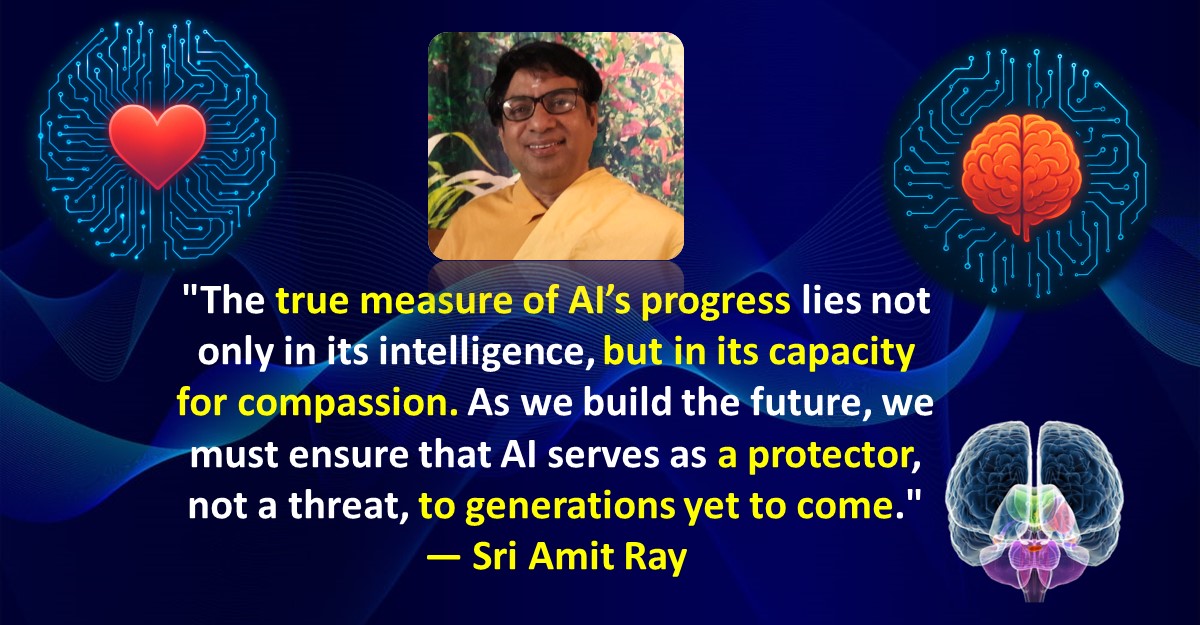
His research on compassionate artificial general intelligence (CAGI), AI ethics, compassionate AI, 114 chakras, quantum attention functions, Toroidal Chakra Fields, and mindfulness-based cognitive spirituality has influenced many scientific and social paradigms.
This article provides an in-depth exploration of Sri Amit Ray’s principal research interests, and pioneering contributions, examining how his interdisciplinary work is influencing the emerging paradigms of compassion-centered technologies, sustainable innovation, spiritual consciousness, and holistic human well-being. By integrating insights from science, 114 chakras, mindfulness, and systems thinking, his vision offers transformative pathways for shaping a more compassionate, resilient, and enlightened global future.
Sri Amit Ray envisions a future where Artificial Intelligence (AI) and Spirituality are not opposing forces but complementary aspects of human progress. His philosophy integrates the power of Quantum AI, Compassionate AI, and Chakra Science to create a harmonious future where technology serves humanity ethically, compassionately, and responsibly, rather than controlling or replacing human values.
Sri Amit Ray is widely regarded as the father of Compassionate Artificial Intelligence for pioneering the integration of empathy, compassion, and ethics into AI systems. He introduced the foundational principles of Compassionate AI, advocating for the development of intelligent systems that prioritize emotional sensitivity, inclusivity, and the well-being of all stakeholders. He did his PhD in Artificial Intelligence in 1993. Science 1993 his focus has been on integrating empathy, compassion, ethics, and human-centered values into AI design and deployment.
AI and the Future of Humanity
Sri Amit Ray’s contributions to artificial intelligence (AI) are pioneering. He is best known for his research on Artificial General Intelligence (AGI), Explainable AI (XAI), AI Ethics, Quantum AI, Compassionate AI, and Value-Driven AI. Ray’s contributions have significantly influenced the discourse on ethical AI, positioning compassion not as an auxiliary feature, but as a core component of next-generation artificial intelligence.
Chakra Geometry as a Latent Manifold
In the Sri Amit Ray’s 256 Chakra system, each chakra he conceptualized as a neuro-energetic attractor in a consciousness field. The higher chakras (from 115 to 256) form multi-toroidal crowns that link with quantum consciousness fields. These are not only metaphysical constructs but can be represented as latent nodes on a neural manifold—with:
-
Energetic coordinates (vibration, emotion, frequency)
-
Physiological correlates (EEG, HRV, BCI signals)
By mapping bio-signals like EEG and HRV onto this structure, we can track chakra dynamics as measurable changes in the neural-geometric field.
Chakra Neural Geometry: Consciousness as Geometry
Chakra Neural geometry refers to the mathematical shapes and topological flow fields that underlie brain and consciousness activity. Ray applied this to the 256 chakras, This includes:
-
Manifold warping: Brain activity patterns folding through high-dimensional fields
-
Signal rotation: Rotation of neural patterns during thought, meditation, or dream states
-
Attractor landscapes: Stable states of consciousness mapped as basins in dynamic geometry
-
Mesh connectivity: Neural pathways behave like flexible, self-adjusting geometric meshes
1. Artificial General Intelligence (AGI)
AGI is the next frontier in AI, aiming to create machines that can perform any intellectual task a human can. Sri Amit Ray has worked on building “human-centered AGI” that incorporates emotional intelligence, ethics, and human values. His research emphasizes AI systems that can learn from minimal data while making fair and unbiased decisions.
2. Explainable AI and AI Ethics
A major challenge in AI is the black-box nature of deep learning models. Ray’s research on XAI aims to make AI systems more transparent, ensuring that their decision-making process is understandable to humans. He introduced frameworks for fairness, accountability, and interpretability in AI, ensuring that AI systems remain aligned with human values.
3. Compassionate AI and Value-Driven AI
Sri Amit Ray pioneered the concept of Compassionate AI, which integrates empathy and emotional intelligence into AI systems. His research ensures that AI is not just intelligent but also humane, capable of understanding and responding to human emotions effectively. Value-Driven AI, another major contribution, focuses on embedding ethical values, fairness, and human well-being into AI models, ensuring that AI contributes positively to society.
4. Quantum AI and Consciousness Studies
Ray’s research explores Quantum Machine Learning (QML), which combines quantum computing with AI to revolutionize fields such as healthcare, finance, and cybersecurity. His work integrates AI with human consciousness studies, opening doors to advancements in AI that mimic human intuition and decision-making.
Quantum Computing and Future Technologies
1. Quantum Computing for Sustainable Development
Quantum computing has the potential to solve complex problems beyond classical computers. Sri Amit Ray’s research in quantum computing algorithms, and quantum AI lays the foundation for next-generation computing technologies. His contributions help accelerate solutions in climate modeling, drug discovery, and energy optimization.
2. Quantum Attention Function
Ray’s Quantum Attention Function research has enhanced quantum deep learning, improving pattern recognition, optimization, and natural language processing. This breakthrough allows quantum AI to analyze vast datasets more efficiently, significantly improving performance in AI applications like healthcare diagnostics and financial modeling.
3. Quantum AI for Healthcare and Medicine
Ray’s work has significantly impacted AI-driven drug discovery and personalized medicine using quantum computing. His models help optimize molecular simulations, leading to more effective treatments for diseases such as cancer and neurodegenerative disorders.
4. Consciousness and Quantum Physics
His “Quantum Consciousness” research explores the intersection of quantum mechanics and consciousness. He postulates that quantum processes in the brain contribute to consciousness, influencing AI models designed to replicate human-like cognition.
Mindfulness and the Future of Mental Well-Being
Sri Amit Ray is renowned for his research on mindfulness, compassion-based therapy, and neuroscience of meditation. His mindfulness teachings focus on integrating modern science with ancient wisdom for human well-being.
1. 114 Chakras and Higher Consciousness
Ray’s research on the 114 Chakras provides a detailed roadmap to expanding human consciousness. He has demonstrated how activating these chakras enhances intuition, creativity, and overall well-being. His work bridges the gap between neuroscience and spiritual traditions, offering a scientific basis for meditation and energy healing.
2. Neuroscience of Meditation
Ray’s meditation-based cognitive enhancement research has shown how mindfulness impacts brain plasticity, memory, and stress reduction. His work is widely used in corporate wellness programs, healthcare, and education.
3. Compassionate AI and Emotional Intelligence
His work emphasizes developing emotionally intelligent AI systems that can recognize human emotions, making AI more humane. These advancements pave the way for AI systems that can reduce stress, assist in mental health therapy, and enhance human creativity.
4. Mindful Leadership and Global Peace
Ray introduced the concept of Mindful Leadership for business, politics, and social activism. His research suggests that leaders trained in mindfulness and compassion make better decisions, leading to sustainable progress.
Sustainable Development and Climate Action
1. AI for Climate Change Mitigation
Sri Amit Ray advocates using AI for climate solutions, including renewable energy optimization, smart grids, and disaster prediction models. His AI algorithms help detect climate patterns, making sustainability initiatives more effective.
2. Holistic Sustainability Approach
He emphasizes holistic sustainability, integrating economic, environmental, and social aspects. His AI-based models for urban planning, waste management, and water conservation contribute to global sustainability efforts.
3. AI and Biodiversity Conservation
Ray’s research in AI-powered wildlife conservation has led to innovations in endangered species protection, habitat monitoring, and ecosystem restoration.
The Future World: A Vision Based on Ray’s Research
Sri Amit Ray envisions a future world where technology, consciousness, and sustainability coexist harmoniously. His AI-driven solutions will shape healthcare, education, governance, and environmental sustainability. His quantum computing breakthroughs will solve some of humanity’s greatest challenges, while his mindfulness and leadership models will cultivate a world of peace and progress.
1. Human-Centric AI
In the future, AI systems will be designed with ethical considerations, ensuring AI serves humanity positively. Ray’s research ensures bias-free, transparent, and compassionate AI systems.
2. Quantum Revolution
Quantum computing will unlock breakthroughs in cryptography, space exploration, and advanced materials, all driven by Ray’s quantum research.
3. Universal Well-Being and Peace
His mindfulness research will reduce global stress, enhance creativity, and promote peace. His leadership frameworks will foster ethical decision-making in politics and corporations.
Conclusion
Sri Amit Ray’s research contributions offer a roadmap for a better future—one where AI, quantum computing, and mindfulness transform humanity. His legacy of human-centered technology and sustainable progress will shape the future world, making it more compassionate, ethical, and technologically advanced.
His vision is not just about technological progress but about creating a world where science and spirituality coexist harmoniously, ensuring a sustainable and prosperous future for all.
References:
- Ray, Amit. “Autophagy in AI: Destructive vs. Constructive.” Compassionate AI, 2.4 (2025): 42-44. https://amitray.com/autophagy-in-ai/
- Ray, Amit. “AI-Driven PK/PD Modeling: Generative AI, LLMs, and LangChain for Precision Medicine.” Compassionate AI, 1.3 (2025): 48-50. https://amitray.com/ai-driven-pk-pd-modeling-generative-ai-llms-and-langchain-for-precision-medicine/
- Ray, Amit. “AI Brick Computing: Scalable and Sustainable Green AI.” Compassionate AI, 1.2 (2025): 33-35. https://amitray.com/ai-brick-computing-scalable-and-sustainable-green-ai/
- Ray, Amit. “Five Steps to Building AI Agents with Higher Vision and Values.” Compassionate AI, 4.11 (2024): 66-68. https://amitray.com/building-ai-agents/
- Ray, Amit. “The 10 Ethical AI Indexes for LLM Data Training and Responsible AI.” Compassionate AI, 3.8 (2023): 35-39. https://amitray.com/the-10-ethical-ai-indexes-for-responsible-ai/
- Ray, Amit. “Ethical Responsibilities in Large Language AI Models: GPT-3, GPT-4, PaLM 2, LLaMA, Chinchilla, Gopher, and BLOOM.” Compassionate AI, 3.7 (2023): 21-23. https://amitray.com/ethical-responsibility-in-large-language-ai-models/
- Ray, Amit. “Calling for a Compassionate AI Movement: Towards Compassionate Artificial Intelligence.” Compassionate AI, 2.6 (2023): 75-77. https://amitray.com/calling-for-a-compassionate-ai-movement/
- Ray, Amit. “From Data-Driven AI to Compassionate AI: Safeguarding Humanity and Empowering Future Generations.” Compassionate AI, 2.6 (2023): 51-53. https://amitray.com/from-data-driven-ai-to-compassionate-ai-safeguarding-humanity-and-empowering-future-generations/
- Ray, Amit. “Artificial intelligence for Climate Change, Biodiversity and Earth System Models.” Compassionate AI, 1.1 (2022): 54-56. https://amitray.com/artificial-intelligence-for-climate-change-and-earth-system-models/
- Ray, Amit. “Quantum Machine Learning: The 10 Key Properties.” Compassionate AI, 2.6 (2019): 36-38. https://amitray.com/the-10-ms-of-quantum-machine-learning/
- Ray, Amit. “Roadmap for 1000 Qubits Fault-tolerant Quantum Computers.” Compassionate AI, 1.3 (2019): 45-47. https://amitray.com/roadmap-for-1000-qubits-fault-tolerant-quantum-computers/
- Ray, Amit. “Quantum Computing with Many World Interpretation Scopes and Challenges.” Compassionate AI, 1.1 (2019): 90-92. https://amitray.com/quantum-computing-with-many-world-interpretation-scopes-and-challenges/
- Ray, Amit. “Artificial Intelligence for Balance Control and Fall Detection of Elderly People.” Compassionate AI, 4.10 (2018): 39-41. https://amitray.com/artificial-intelligence-for-balance-control-and-fall-detection-system-of-elderly-people/
- Ray, Amit. “Quantum Computer with Superconductivity at Room Temperature.” Compassionate AI, 3.8 (2018): 75-77. https://amitray.com/quantum-computing-with-superconductivity-at-room-temperature/
- Ray, Amit. “Artificial Intelligence to Combat Antibiotic Resistant Bacteria.” Compassionate AI, 2.6 (2018): 3-5. https://amitray.com/artificial-intelligence-for-antibiotic-resistant-bacteria/
- Ray, Amit. “Navigation System for Blind People Using Artificial Intelligence.” Compassionate AI, 2.5 (2018): 42-44. https://amitray.com/artificial-intelligence-for-assisting-blind-people/